Geopolitical Research Institute(GRI)/Εταιρεία Γεωπολιτικών Ερευνών(ΕΓΕ)

Σάββατο 15 Αυγούστου 2015

Η Γεωπολιτική Ισχύς της Ελλάδος


Τους τελευταίους δύο μήνες με αποκορύφωμα τον περασμένο Ιούλιο η Ελλάδα βίωσε ίσως την πιο εφιαλτική περίοδο των τελευταίων 40 ετών ακροβατώντας μεταξύ επιβίωσης και απόλυτου ολέθρου. 
Τελικά, και παρά το γεγονός ότι επετεύχθη μια προκαταρκτική συμφωνία στις 13 Ιουλίου μεταξύ Ελλάδος και διεθνών δανειστών η αποσταθεροποίηση δεν απεφεύχθη στους κύριους πυλώνες σταθερότητας δηλαδή την πολιτική και την οικονομία (θυμίζουμε απλά τις κλειστές τράπεζες, τα capital controls, την παύση λειτουργίας του χρηματιστηρίου, το σκηνικό έντονης πολιτικής αστάθειας, το δημοψήφισμα και άλλα πολλά..). Όλα τα παραπάνω αποτελούν τις άμεσες ενδείξεις μιας παραπαίουσας πολιτικοοικονομικής κατάστασης η οποία ξεκινώντας από την Ελλάδα επηρεάζει άμεσα τις δυναμικές, τις ισορροπίες, τις συμμαχίες στην ευρύτερη περιοχή της ΝΑ Ευρώπης, έναν χώρο ζωτικό για την ανάπτυξη της Ελλάδας και την δημιουργία σφαιρών επιρροής.
Οι χώρες της Βαλκανικής χερσονήσου εξαιρουμένης της Ελλάδος και με την πρώην Γιουγκοσλαβία διασπασμένη σε 7 διαφορετικές κρατικές οντότητες (Σλοβενία, Κροατία, Βοσνία-Ερζεγοβίνη, Σερβία, Μαυροβούνιο, Κόσοβο, ΠΓΔΜ) αποτελούν ζώνες επιρροής και ιδιότυπα buffer states, όπου η γεωπολιτική σκακιέρα σχηματίζεται αναλόγως των συμφερόντων των ισχυρών. Ο ρόλος δε της Ελλάδας στην περιοχή αυτή είναι διάφορος, ιδιαίτερος και άκρως σημαντικός αφού πληροί τις περισσότερες από τις 4 βασικές παραμέτρους γεωπολιτικής ισχύος (Άμυνα-ασφάλεια, Οικονομία-ενέργεια, Πολιτική και Πολιτισμός) ενώ βρίσκεται αναγκαστικά σε ανταγωνισμό με την γείτονα Τουρκία η οποία κι εκείνη απ’ την πλευρά της πληροί τις παραπάνω παραμέτρους και σε υπερθετικό μάλιστα βαθμό. Η δε Τουρκία με ένα πλέγμα δραστηριοτήτων και ένα πλήθος επενδύσεων, σε κατασκευαστικά έργα, χρηματοοικονομικές υπηρεσίες, ενεργειακές υποδομές, διακρατικές συμφωνίες, ανάπτυξη πολιτισμικών σχέσεων κ.α. έχει δημιουργήσει μια ισχυρή βάση επιρροής.
Απ’ την άλλη η Ελλάδα με επίσης βαθιές πολιτισμικές ρίζες στην ευρύτερη ΝΑ Ευρώπη, προσπάθησε μετά την πτώση των κομμουνιστικών καθεστώτων να αναπτύξει μια δραστήρια παρουσία στις παραπάνω χώρες κυρίως στον τραπεζικό τομέα, στον ενεργειακό, κατασκευαστικό και στον τομέα των τηλεπικοινωνιών. Αν και ο τραπεζικός τομέας κι αυτός των τηλεπικοινωνιών ήταν οι κυρίαρχες ελληνικές δραστηριότητες ωστόσο και οι επενδύσεις στην ενέργεια έπαιξαν σημαντικό ρόλο στην ανάπτυξη της ελληνικής επιρροής. Θυμίζουμε την δραστηριότητα των ΕΛΠΕ σε όλη την ΝΑ Ευρώπη στην αγορά καυσίμων, το διυλιστήριο της ΟΚΤΑ στην ΠΓΔΜ, τον αγωγό πετρελαίου Θεσσαλονίκης – Σκόπια, τις ελληνικές επενδύσεις στα υδροηλεκτρικά της Αλβανίας, τις διασυνοριακές συνεργασίες στις ηλεκτρικές διασυνδέσεις καθώς και σχέδια για διασυνδέσεις φυσικού αερίου ( IGB, Vertical Corridor) πολλά εκ των οποίων αποτελούν ελληνικές πρωτοβουλίες. Από την άλλη η ύπαρξη μεγάλων και φερέγγυων εγχώριων ενεργειακών εταιρειών (στον ηλεκτρισμό, στα πετρελαιοειδή, στο φυσικό αέριο, στις ΑΠΕ) ήτο πάντοτε μια σταθερή εγγύηση που εξασφάλιζε την ισχυρή θέση της Ελλάδος στην περιοχή και αύξανε την οικονομική και ως εκ τούτου και την γεωπολιτική επιρροή της.
Ωστόσο με την αρχή της οικονομικής κρίσης το 2011 και πολύ περισσότερο με την οικονομική καταστροφή που συνετελέσθη τους τελευταίους μήνες σε χρηματοοικονομικό επίπεδο, η θέση της Ελλάδος στην περιοχή έχει εξασθενίσει σημαντικά ενώ η ελληνική παρουσία στην Ρουμανία, Σερβία και Αλβανία τείνει συνεχώς μειούμενη με την εξαίρεση ίσως της Βουλγαρίας όπου κάποιες ελληνικές εταιρείες βρήκαν ένα προσωρινό καταφύγιο. Η αξιοπιστία όμως της Ελλάδος έχει βληθεί αν όχι ανεπανάληπτα σίγουρα δραματικά στην ΝΑ Ευρώπη ενώ η πολιτική αποσταθεροποίηση στο εσωτερικό της χώρας εξάγεται ως σύμπτωμα γεωπολιτικής αστάθειας στις χώρες της περιοχής που σε συνδυασμό με έξαρση άλλων φαινομένων όπως το ισλαμικό κίνημα, οπλισμένες απελευθερωτικές ομάδες ( UCK), όξυνση στο τρίγωνο Σερβίας – Αλβανίας – Κοσσόβου, δυναμιτίζει ακόμα περισσότερο την σταθερότητα της περιοχής .
Σε αυτό το κλίμα θα πρέπει κανείς να δει την περιοδεία που έκαναν σημαντικοί Δυτικοί αξιωματούχοι κυρίως στα δυτικά Βαλκάνια όπως η Αμερικανίδα υφυπουργός Εξωτερικών, Βικτόρια Νούλαντ, ο Γερμανός πρόεδρος του Ευρωκοινοβουλίου Μάρτιν Σουλτς, ο Νορβηγός ΓΓ του ΝΑΤΟ, Γενς Στόλτενμπεργκ καθώς και η Γερμανίδα Καγκελάριος Άγγελα. Μέρκελ που επισκέφθηκε την Αλβανία. Όλοι οι παραπάνω αξιωματούχοι πέρασαν το τελευταίο τρίμηνο από τα Δυτικά Βαλκάνια υποσχόμενοι αφενός τη «στήριξη» στις φιλοδοξίες για ένταξη των χωρών σε ΕΕ και ΝΑΤΟ ενώ έδειξαν απειλητικές διαθέσεις σε όλους όσους φλερτάρουν ακόμη και με την ιδέα μίας πιθανής συνεργασίας με τη Ρωσία. Πιο ξεχωριστή και σημαντική ίσως απ’ όλες τις επισκέψεις - παρέμβαση ήταν αυτή της Αμερικανίδας Βικτόρια Νούλαντ η οποία πραγματοποίησε περιοδεία σε Κροατία, Βοσνία - Ερζεγοβίνη, Κοσσυφοπέδιο, ΠΓΔΜ, Μαυροβούνιο, Σερβία και Αλβανία.
Το ίδιο διάστημα (τέλη Ιουνίου – μέσα Ιουλίου) και ενώ η Ελλάδα βρισκόταν μεταξύ σφύρας και άκμονος και ενώ επιτελούνταν ένας πραγματικός Αρμαγεδώνας πολιτικών και οικονομικών εξελίξεων στο εσωτερικό της χώρας, είναι ιδιαίτερα ενδιαφέρον και φυσικά διόλου τυχαίο ότι ο υπουργός Εξωτερικών κ. Νίκος Κοτζιάς πραγματοποιούσε μια μεγάλη περιοδεία σε ΠΓΔΜ, Σερβία, Μαυροβούνιο, Αλβανία, Βοσνία - Ερζεγοβίνη και Κόσσοβο προσπαθώντας να διασκεδάσει αφενός τις υποψίες για επέκταση της ελληνικής κρίσης στην γύρω περιοχή αλλά και να κάνει εμφανές ότι η Ελλάδα παραμένει παράγοντας σταθερότητας, επενδυτικής αξιοπιστίας και γεωπολιτικής ισχύος στην περιοχή. Ιδιαίτερα δε όταν το Υπουργείο Παραγωγικής Ανασυγκρότησης, Περιβάλλοντος και Ενέργειας με επιπολαιότητα, μονοδιάστατα και με πλήρη πολιτική αστοχία έκανε σχέδια επί χάρτου θέτοντας τον τουρκικό αγωγό και την επέκτασή του στην Ελλάδα ως προμετωπίδα της εθνικής ενεργειακής πολιτικής, το Υπουργείο Εξωτερικών ορθώς πράττον προσπαθούσε να αναπτύξει περαιτέρω τις γέφυρες επικοινωνίας με τα κράτη των Δυτικών Βαλκανίων τονίζοντας τον ευρωπαϊκό τους προσανατολισμό και αποτρέποντας την πλήρη απομόνωση της Ελλάδος από τα γειτονικά κράτη εξαιτίας των πολιτικών εξελίξεων.
Φυσικά αυτό από μόνο του δεν είναι αρκετό. Η Ελλάδα αν θέλει να αυξήσει την επιρροή της στην περιοχή πρέπει να δουλέψει πρώτα απ’ όλα στο εσωτερικό της, στην ανάπτυξη των τεσσάρων παραμέτρων γεωπολιτικής ισχύος και σ’ αυτήν την προοπτική ο τομέας της ενέργειας μπορεί να παίξει ουσιαστικό ρόλο. Οι στρατηγικές επενδύσεις που αφορούν στην κατασκευή FSRU στη Βόρεια Ελλάδα, η περαιτέρω ανάπτυξη του LNG, η κατασκευή της υπόγειας αποθήκης φυσικού αερίου στον Πρίνο, o IGB και ο Vertical Corridor αυξάνουν την ασφάλεια ενεργειακού εφοδιασμού ολόκληρης της περιοχής κι έτσι ενισχύεται η πρώτη παράμετρος της γεωπολιτικής ισχύος που είναι η Άμυνα – Ασφάλεια. Από την άλλη η εξωστρεφής στρατηγική των μεγάλων ελληνικών ενεργειακών εταιρειών στην περιοχή και η συμμετοχή τους είτε ανεξάρτητα είτε σε κονσόρτσια σε projects της περιοχής θα φέρει ένα συγκριτικό πλεονέκτημα στην δεύτερη παράμετρο γεωπολιτικής ισχύος που είναι η Οικονομία – Ενέργεια. Η τρίτη παράμετρος δηλαδή η πολιτική θα πρέπει να κινείται στα πλαίσια της μακροχρόνιας εθνικής στρατηγικής σε όλους τους τομείς, όπως στον νευραλγικό τομέα της ενέργειας με ελάχιστες διορθωτικές παρεκκλίσεις δίδοντας μ’ αυτόν τον τρόπο την εικόνα στο εξωτερικό της σταθερότητας και της αξιοπιστίας. Τέλος, η τέταρτη παράμετρος γεωπολιτικής ισχύος δηλαδή ο πολιτισμός είναι ένας ευρύς τομέας που θα μπορούσε να γίνει εύκολα εκμεταλλεύσιμος με πάρα πολλούς τρόπους. Στον τομέα της ενέργειας επί παραδείγματι θα μπορούσε η Ελλάδα να γίνει κέντρο για όλη την περιοχή, εκπαίδευσης και επιμόρφωσης σε τεχνολογίες ΑΠΕ και εξοικονόμησης ενέργειας, κεφαλαιοποιώντας έτσι την μεγάλη της εμπειρία στους συγκεκριμένους κλάδους.
Ανακεφαλαιώνοντας τα παραπάνω μπορούμε πολύ εύκολα να συμπεράνουμε ότι η τελευταία κρίση στην Ελλάδα που για πολλούς σήμανε το τέλος της μεταπολίτευσης, δεν θα γίνει η απαρχή νέων εξελίξεων και δημιουργίας συγκριτικών πλεονεκτημάτων αν δεν μεταλλαχθεί άρδην ο τρόπος με τον οποίον βλέπουμε την Ελλάδα ως πολιτική, οικονομική και πολιτισμική οντότητα στην ευρύτερη γεωγραφική περιοχή της ΝΑ Ευρώπης η οποία και αποτελεί για τη χώρα μας φυσική προέκταση δραστηριότητας, ανάπτυξης και ωφέλιμων συνεργασιών.

Η Κύπρος ζητάει από την Τουρκία να αποσύρει το στρατό κατοχής και να εφαρμόσει τις αποφάσεις του ΟΗΕ


Second phase of invasion remembered
Σήμερα είναι η θλιβερή επέτειος της επέκτασης της τουρκικής κατοχής η β φάση της.Η κυπριακή κυβέρνηση με γραπτή της δήλωση καλεί την Τουρκία ν΄ αποσύρει τα στρατεύματα κατοχής από την Κύπρο και να θέσει σε εφαρμογή τις αποφάσεις του ΟΗΕ. Ήταν 14 Αυγούστου του 1974 όταν οι τουρκικές ορδές διεύρυναν την κατοχή καταλαμβάνοντας τον τουριστικό σταθμό της Varosha στα ανατολικά και την πλούσια σε αγροτική παραγωγή εύφορη περιοχή της Μόρφου στα δυτικά.
Οι κάτοικοι της Βαρόσα εγκατέλειψαν τις εστίες τους έγιναν πρόσφυγες στον ίδιο τους τον τόπο υπό την προέλαση του στουρκικού στρατού κατοχής του εισβολέα. Αντίθετα με άλλες περιοχές στα κατεχόμενα η Βαρόσα παραμείνει πάντα ακατοίκητη 41 χρόνια μετά  και δεν έγινε εποικισμός όπως συνέβη μαζικά στις υπόλοιπες περιοχές της Βόρειας Κύπρου που αλλοίωσαν τον δημογραφικό χάρτη της νήσου.Συνολικά το 37%  της νήσου της Αφροδίτης παραμένει υπό τουρκική κατοχή. Οι τουρκικές ένοπλες δυνάμεις εισέβαλαν στην Κύπρο στις 20 Ιουλίου 1974 5 ημέρες μετά την ανατροπή Μακαρίου.
Στη συνέχεια της τουρκικής κατοχής 2 διασκέψεις έλαβαν χώρα στην Ελβετία.Στην πρώτη συμμετείχαν Αγγλία,Ελλάδα και Τουρκία και στην δεύτερη υπήρξε και η παρουσία ελληνοκύπριων και τουρκοκύπριων εκπροσώπων.Ο β γύρος των διαπραγματεύσεων  οδηγήθηκε σε αδιέξοδο καθώς ο Κληρίδης ζήτησε 36 ώρες για να εξετάσει την πρόταση της Τουρκίας για μια ομοσπονδία στην Κύπρο που θα έδινε αυτονομία τους τουρκοκύπριους. Η Τουρκάι αρνήθηκε και μερικές ώρες αργότερα εξαπέλυσε και την δεύτερη φάση επίθεσης.
Στις 13 Φεβρουαρίου του 1975 η Τουρκία ανακήρυξε το κατεχόμενο βόρειο  τμήμα της νήσου  Τουρκικό Ομόσπονδο Κράτος της Κύπρου.(cyprus-mail 14.8.15)

The Greek Influence in the Caribbean: Faros in El Moro and Barbados Paleologos Plantation


ferdinando2


American tourists to the Caribbean are amazed by the Greek influence. A subjugated people, without a country, the Greek culture made its mark in the new world. Greek mariners, with Hispanic names navigated the waters. But, the Greek language also made its mark on the Caribbean.
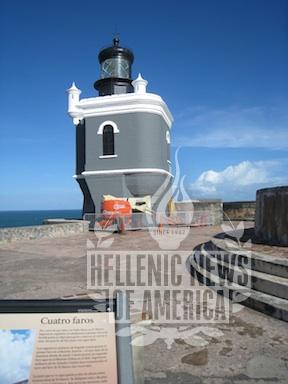
            “The word faros in Spanish comes from the Greek language,” said the park ranger at the Castillo San Felipe del Morro (El Morro) in Puerto Rico. “It means light house. What did the Greeks not invent? The first lighthouse was the Colossus of Rhodes, one of the seven marvels of the ancient world, before the famed lighthouse of Alexandria, Egypt.”  This revelation was part of a free tour of El Morro, the 16th century citadel, conducted in San Juan, Puerto Rico. Every Saturday and Sunday afternoons, a free trip of the lighthouse is offered in El Morro Castle to the public.
            El Moro was built on the northwestern point of San Juan, Puerto Rico, in honor of king Philip II of Spain in 1539. The lighthouse was built on top of the Castillo in 1843. In 1908, the U.S. military replaced it with the current lighthouse. The original lighthouse was destroyed by US warship fire during the 1898 bombardment of the city. In 1983, El Moro was declared a World Heritage site. El Morro was a Spanish defensive military fortification that protected Puerto Rico, “the Key to the Antilles”.
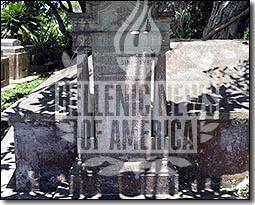
            The Paleologos family of Byzantium left its imprint in Barbados. According to the Cemetery and Memorial Parks website of Barbados, “One intriguing feature of the St John’s Parish Church Cemetery is probably found outside in the graveyard where the tomb of Ferdinando Paleologus (son of Theodore) rests. Paleologus was a descendent of the brother of the great Emperor Constantine XI, the last of the Byzantine Imperial family from the 1400’s that produced the last Christian emperors of Greece. He fled to Barbados after the 1645 Battle of Naseby in England….. He was a church warden of St. John’s Parish having lived there for 20 years where he owned a 197-acre plantation. He managed it from 1649 to 1670 and later died there in 1678.When Paleologus died, he was naturally buried in the St John’s Parish Church, since he had been a prominent person in that community. He left behind a legacy of mystery which until 1844 was buried at St John’s. It was said that he was buried ‘backways’. The rumors persisted until nearly 200 years later in 1844 when a curious church official ordered the vault opened.”
Faros1

            “Paleologus lead coffin was found to have been in a different position to all the others. As the lid was opened, his skeleton was found lodged in quicklime. He had been buried according to Greek Orthodox traditions, which amongst other things, demanded that the dead person’s head should point to the west and their feet to the east. The dignified memorial, wrought in Portland stone portrays a Greek temple with Doric columns surrounding the cross of Constantine carved in the center. The following inscription may still be read:
Here lyeth ye body of
Ferdinando Paleologus
Descended from ye imperial lyne
Of ye last Christian
Emperors of Greece
Churchwarden of this Parish
1655-1656
Vestryman, Twentye years
Died Oct. 3 1678

The estate of Ferdinando still survives today (2005) as a working farm now called the “Ashford Plantation”. Inevitably becoming a tourist attraction, since in the 1980s, when the Ashford Bird Park and animal sanctuary were opened there.”  Greek language and culture is a treasure belonging to the international community.

Πέμπτη 13 Αυγούστου 2015

Juan Griego


Juan Griego
(1566-After 1631)

Family Links
Spouses/Children:
Pascuala Bernal


  • Born: 1566, Negroponte, Candia, Greece (Crete)
  • Marriage: Pascuala Bernal
  • Died: After 1631, Nuevo Méjico, Nueva España
bullet  Noted events in his life were:
• Background Information. 252
Juan Giego answered the Onate muster-roll at Casco in 1597, declaring that he was accompanied by his wife, and that he was a native of the City of Candia in Greece, the son of Lázaro Griego. On another occasion, the same year, he gave "Negroponte" as his birthplace, and this is the place he also gave in 1598, when he was entered as the son of Lázaro Griego, thirty-two years old, a native of Greece in "Negropote," of good stature, greay-bearded, with a big wound on the forehead. If born in or near Candia, Crete, he was not only a contemporary but also a fellow-townsman of the great painter in Spain, Domenico Theotocopuli, otherwise known by his Italo-Spanish nickname of "El Greco." Was Juan Griego's family name also so hard to pronounce that even his father was known as "the Greek"?

Still living, and an Alférez, in 1631, Juan gave his age as sixty. His wife, Pascuala Bernal, was dead by 1626. Their known sons were; Juan II, Lázaro, and Francisco (this latter went by the name of Bernal). Their daughters wereCatalina Bernal, wife of Juan Durán, María Bernal, married to Juan Gómez Barragán, Ysabel Bernal, wife of Sebastián González, and Juana Bernal, married Diego de Moraga.

Origins of New Mexico Families: A Genealogy of the Spanish Colonial Period, p. 41

Juan married Pascuala Bernal. (Pascuala Bernal was born in 1583 in Valle de Méjico, Nueva España and died before 1626 in Santa Fé, Santa Fé, Nuevo Méjico, Nueva España 252.)

DE FUCA, JUAN


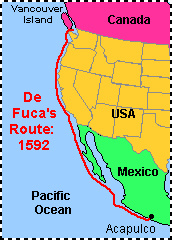
Juan de Fuca (15??-1601?) was a Greek navigator who sailed for Spain under a Spanish name; his original name was Apostolos Valerianos. De Fuca sailed up the western coast of North America from Mexico to Vancouver Island in 1592, looking for a passage from the Pacific Ocean to the Atlantic Ocean. He was perhaps the first European to see this area. He sailed through the Strait of Juan de Fuca (which was named for him in 1725) and believed it to be the beginning of a route to the Atlantic Ocean (it is not). This strait connects the Pacific Ocean to the Puget Sound and the Georgia Strait, and is located between the Olympic Peninsula of Washington state, USA, and Vancouver Island, British Columbia, Canada.After sailing back to Acapulco, Mexico, de Fuca was not rewarded by Spain for his journey, and his discovery of the strait was not entirely believed until Captain Vancouver retraced de Fuca's route 200 years later.
DE ONATE, JUAN
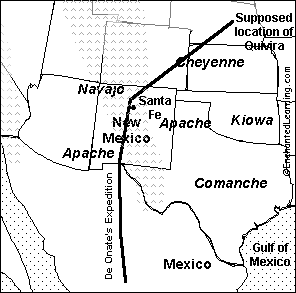
Juan de Oñate y Salazar (1550?-1626) was a Spanish conquistador who established the colony of New Mexico for Spain and became New Mexico's first governor. Oñate, the son of a conquistador who made a fortune in silver, was married to a granddaughter of Hernán Cortés. In 1595, Oñate requested that he be sent to conquer and rule New Mexico, search for treasure (especially the legendary silver treasure of Quivira), and bring Christianity to the local Indians. After governmental approval, Oñate left for New Mexico in January, 1598, with 400 settlers and soldiers (and their livestock). In July 1598, the expedition crossed the Rio Grande at El Paso. They arrived at the Tewa pueblo of San Juan and were helped by the local Indians. Oñate's group built San Gabriel, New Mexico's first capital. After they realized that the area was not rich in silver, many settlers wanted to return to Mexico, but Oñate would not let them go, and executed many of them. He was also incredibly brutal to the local Indians, killing, enslaving, and mutilating hundreds of Indian men, women, and children.In 1601, Oñate led an expedition to the Great Plains of America that tried, unsuccessfully, to find the legendary silver of Quivira (thought to be in what is now central Kansas, east of Salina). While he was gone, most of his settlers returned to Mexico City. In 1604, he explored the area west toward the Colorado River and south to the Gulf of California. In 1606, Oñate made plans for the town of Santa Fé.
Later in 1606, Spain removed him from office (Don Pedro de Peralta was appointed to be the new governor); Oñate was later tried and found guilty of cruelty, immorality, mismanagement, dereliction of duties, and false reporting. Oñate was exiled from the colony. Later, on appeal, he was was cleared of the charges. Onate, 

Pedro de Candia / Greece, Crete Heraklion 15th century


Looking information, pictures, documents, relatives, etc of CANDIA, Pedro de, Greek adventurer, born in the island of Crete Heraklion in the latter part of the 14th century; died in Chupas, Peru, 16 September, 1542. He had served in the Spanish royal guard, and fought in Italy against the Turks, and afterward went to America with Governor Pedro de los Rios.

He then accompanied Diego de Almagro and Francisco Pizarro during their first explorations along the coasts of Peru, and when the landing at Atacamez, north of Guayaquil, was effected, he already had command of the artillery. He was one of the thirteen men that remained in the islands of Gallo and Gorgona or San Cristobal with Pizarro, and during the subsequent explorations of the Peruvian ports he undertook to go in person to the Indian towns and investigate their condition.

He then visited Tumbez (afterward called Valencia), and returned to the fleet with a map of that City drawn on canvas. When he accompanied Pizarro to Spain to inform Charles V. of their discoveries, the emperor made Candia a nobleman, mayor of Tumbez, and commander-in-chief of artillery of the fleet sent out to conquer Peru.

He was present at the defeat and imprisonment of Atahualpa, and received a large share of the ransom paid by that Inca. While residing at Cuzco, he made arms and ammunition for Pizarro, who was then fighting against Almagro. After the defeat of Almagro at Las Salinas, Candia undertook the conquest of Ambaya beyond the Andes, but was unsuccessful, being finally arrested by order of Hernando Pizarro.

Disgusted at his treatment, and deserted by his old friends, he then joined the followers of Almagro and, with the aid of sixteen other Greeks, cast the guns that were taken by young Almagro to the battle of Chupas, where Candia used them so badly that Almagro suspected treason on his part and killed him with his own hand.

Pedro de Candia and the Conquest of the Incas


The European discovery and conquest of the New World has been justly characterized by historians as a momentous event whose impact affected the future course of humanity both positively and negatively. For while it gave the Europeans, inter alia, immeasurable riches and imperial glory, it conversely brought calamity to the indigenous peoples of the Americas, whose states and empires were eradicated by the conquerors. Yet, the subsequent "exchanges" of European and Indian, both cultural and biological, ultimately resulted in the ethnogenesis of the modern Latin American nations, whose native component in such regions as the Andean, remains vital, even dominant.
This synoptic study purports to examine the role played by the Greek artillery officer Pedro de Candia in the conquest of the Incas, a cataclysmic occurrence causing the demise of the greatest native empire of the New World, which stretched over 2500 miles along the western coast of South America. Incidentally, it points to the fact that the perpetrators of this dastardly deed were not exclusively Spaniards, or Iberian peninsulares generally, but also Levantine mercenaries in the service of Castille, who had fled to the West as a consequence of the expansion of the Ottoman Muslims into the Byzantine East. Thus, victims of a brutal conquest at one end of the world had, mutatis mutandis, joined the ranks of conquerors at the other end. The study, based primarily on the translated works of Pedro`s nearly contemporary Garcilaso de la Vega and the classic work of Prescott which incorporates additional early sources of the conquista, along with relevant materials on the Greek presence in Spain and its provenance, constitutes an undergraduate`s attempt to gain some understanding of one of the most colorful of the conquistadores, whose actions contributed to the obliteration of the most majestic of the indigenous empires of the Americas!
       One of our primary sources of information regarding Pedro de Candia consists of the memoirs of Garcilaso de la Vega (1539-1616), the son of an Inca princess and a conquistador who belonged to the first generation of Spaniards coming to the Americas after Columbus. This monumental work masterfully edited and introduced by Alain Gheerbrant (The Incas, The Royal Commentaries of the Inca Garcilaso de la Vega 1539-1616. London: Cassel, 1963) is an indispensable guide to the student of the conquest of the Incas. Though Garcilaso had left Peru in 1560, at the age of 21 to serve for 30 years in the Spanish army, his dual loyalties and historical experiences emanating from his mixed ancestry, enabled him to gain a profound understanding of both the Inca and Spanish perspectives on the clash of the two cultures. It is to be noted that some modern scholars have questioned his accounts of the evolution of the Inca empire and its institutions prior to Pizarro`s time, noting discrepancies with other chroniclers (see, J. Malden Mason, The Ancient Civilization of Peru, Pelican ed. Reprinted 1961, pp. 109-110). However, in matters relating to the conquest, his credibility is rarely challenged. Regarding Pedro de Candia, Garcilaso speaks authoritatively, perhaps drawing information on the conqueror inter alia, from Pedro`s son, whom he knew personally from grammar school in Cuzco. This acquaintance suggests that Garcilaso may have been exposed to family traditions or versions of Pedro`s role in the Inca drama, which could have colored his own interpretation of the persona and exploits of the Greek conquistador. Similarly, Garcilaso`s royal Inca ancestry through his mother Isabel Chimp pu Ocelo, cousin of Huascar, Atahualpa`s brother and challenger for the throne, might have disposed him to be inimical to the Inca emperor who in 1532 had ordered the mass slaughter of Huascar`s family, a fate his mother barely escaped (Mason, p. 131). Scholars, however, such as P.A. Means, generally consider Garcilaso`s work to be the basis of the pro-Inca tradition of the conquest in opposition to interpretations following Francisco of Toledo`s Spanish perspective (Cf. Gheerbrant, The Royal Commentaries, pp. XL-XLVIII).
      In recounting the first exploits of Pizarro, Garcilaso (Royal Commentaries, p. 313) records that among the 13 companions of the conqueror was a Greek named Pedro de Candia = Peter of Crete, (the island was known as Candia then), whom he describes as a strong, brave, good Christian man of imposing size and physique. Though Garcilaso had not seen Pedro personally, he could assign to him these physical characteristics with confidence, since he knew in school his 12 year old son, whose size was twice that of his schoolmates. In this account, it was Pedro who requested permission from Pizarro to explore singly the valley of Tumbez, thus becoming the first European to land in Inca territory. However, Mason, (p.131f.), following Prescott and his primary sources, places the first invasion of Inca territory much earlier, in 1523, when Alejo Garcia invaded their land through Paraguay. Garcilaso`s description of Pedro`s landing in Tumbez is colorful and dramatic: Dressed in an impressive military manner, armed with a sword and shield and holding in his right hand a wooden cross, 3 feet long, he proceeded to the city with confidence and an air of dominance, to the great amazement of the natives who wondered whether the bearded newcomer was human or a god! Thus, the elders of Tumbez and the Inca official known as Curaca, determined to solve this enigma by releasing on Pedro the untamed tiger and lion (Jaguar), kept for their king Huaina Kapac. Then, a miraculous event occurred: The wild beasts approached and sat quietly at Pedro`s feet while he held the cross above them, thus demonstrating to the Indians the power of the Christian symbol. Convinced of his divinity, they began to worship him as the son of the Sun and revealed to him their immense treasures, amazing him as much as he had amazed them!
       Subsequently, Garcilaso relates that Pedro failed to convince his companions of the many wonders he had witnessed; thus, the ship returned to Panama leaving behind 2-3 Spaniards to await the future return of the rest. The remaining account of Pedro`s story is disjointed in Gheerbrant`s discussion which makes no reference to other sources (Royal Commentaries, pp. 414-415 n. 5): Pedro`s life, like that of many other conquistadores ended tragically. While serving as a chief artillery officer of the younger Diego de Almagro against the government forces of Vaca de Castro at the battle of Chupas in 1542, he was struck and killed by his employer who suspected him, perhaps justifiably, of treachery and complicity with the enemy. Gheerbrant also records the origins of the 13 companions of Pizarro, a motley force consisting of 3 Castillans, 4 Andalucians, 5 others and one Greek (pp. 414-415 n. 4). Thus, the data relating to Pedro de Candia`s exploits in Garcilaso and his editor, though important, are incomplete.
       Fortunately Prescott, one of the giants of 19th century historiography, whose literary style and acumen recall the greatness of Gibbon and Thucydides, has provided us with additional information on Pedro`s activities drawn from sources that supplement Garcilaso (William H. Prescott, History of the Conquest of Peru, Everyman`s Library, 1963). Thus, he is one of the 13 men on the island of Gallo who crossed the symbolic line drawn by Pizarro inviting them to follow him in a campaign to the land of the Incas (p. 159 and n. 1-3). In Prescott`s account, the pilot Ruiz was the first to do so, followed by Pedro de Candia, who is identified as a cavalier, a man of noble status. This information, based on Montecinos` Anales, refers to Pedro de Candia as Griego, natural de Candia and gives the names of the other 12 companions of Pizarro.
       A second mention of Pedro de Candia in Prescott`s account of the conquest of the Incas is associated with the landing at Tumbez (pp. 165-169).  In this version, it was Alonso de Molina with a Negro companion who, at the invitation of a local Inca official (orejon), a previous visitor to Pizarro`s ship, first landed at Tumbez. Molina`s description of the riches he encountered there, however, failed to convince Pizarro who questioned his veracity and "resolved to send a more discreet and trustworthy emissary on the "following day" (p. 167) to provide him with a more reliable report. This information, drawn from Herrera and Zarate, if trustworthy, reveals the special relationship of Pizarro with his Greek companion, whom he entrusted with such an undertaking in preference to his own Spanish compatriots! For it was Pedro de Candia, the "Greek cavalier" who, armed with his sword and his arquebuse, was sent on shore and dazzled the natives with his splendid appearance and magnificent display of military skills. In this instance, Prescott also records the jaguar incident, basing his version on Herrera, Cieza de Leon and Garcilaso, as he claims (p. 168 n.1): "But Don Pedro was a good Catholic and he gently laid the cross which he wore around his neck on the animal`s back," which was crouching at his feet." In Garcilaso`s narrative, however, Pedro carried a large wooden cross in his hand, which suggests that Prescott`s account is not based on him, but the other sources cited. This discrepancy, along with the claim that Pedro de Candia, rather than Alonso de Molina, was the first European to land at Tumbez, reinforce the suspicion that Garcilaso`s source was Pedro de Candia`s son who may well have recalled his family`s version of these events. Given the fact that both Pedro`s and de Molina`s narratives of the Tumbez landing had been questioned by their companions, Pedro`s family claims have as much validity as the competing account. The subsequent description of the marvels Pedro witnessed at Tumbez (pp.168-169), especially that of the gardens of the convent destined for Inca brides, "glowing with imitation of fruits and vegetables all in pure gold and silver," which was drawn from Mentocinos` Anales, does not appear to have been convincing to Pizarro, as Prescott notes. However, when the conqueror left Panama for Spain in 1528 to report on the discoveries and request the endorsement of a campaign for the conquest of Peru, a scheme opposed by the governor of Panama, Pedro de los Rios, he took with him Pedro de Candia, along with some natives, 3 llamas, and Inca golden objects, to help him make his case (Prescott, based on Montesinos, pp. 175-177). The selection of Pedro suggests again that he was Pizarro`s close confidant, the most talented and influential of his legendary 13 companions and possibly a man of considerable reputation in Spain. Thus, Charles I was convinced by the two men to approve the plan for the conquest of the Incas, and appointed Pizarro governor of Peru, while Pedro de Candia was officially named chief of artillery of the fleet dispatched to the New World, a position he held until his tragic death (Prescott, p. 187).
      Pedro`s crucial role in the conquest of the Incas was again manifested at the battle of Cajamarca in 1534, where he appeared with a few soldiers and his artillery, which he stationed in the city`s fortress. It was from this locality that the fatal artillery blast was fired, perhaps by Pedro himself, that gave the signal for the fierce attack of the Spaniards which resulted in the slaughter and destruction of the Inca people and army and the capture of King Atahualpa (pp. 254-256). The use of artillery, commanded by Pedro, was the decisive factor causing the defeat of the Incas, for as Prescott relates: "The latter (Incas) taken by surprise, stunned by the report of artillery and muskets, the echoes of which reverberated like thunder from the surrounding buildings, and blinded by the smoke which rolled in sulphurous volumes along the square, were seized with a panic" (pp. 253-254). For they were literally "helpless before Spanish guns, armor and horses," as historians note (See e.g. J.A. Ellis, Latin America: Its People and Institutions. New York: The Bruce Publishing Co., 1971, p. 45).
      In discussing the subsequent wars of the Almagros against the Pizarros, Prescott also provides materials drawn from other sources that shed additional light on Pedro`s activities in the land of the Incas (pp. 444-445). In the uprising of 1542, the younger Almagro`s forces were strengthened by the large cannons built under the supervision of Pedro de Candia, "who, with a number of his countrymen-Levantines as they were called-was well acquainted with this manufacture." This account takes into consideration facts which were either ignored or considered by Garcilaso to be trivial, i.e. the presence of a group of Levantine Greeks in the Spanish conquista. Moreover, the association of these Levantines with the manufacture of weapons and cannons, which had played decisive roles in the defeat of the Incas at Cajamarca and affected to a considerable degree the outcome of the Almagro-Pizarro wars, makes their presence in the New World significant. Clearly, the contribution of Pedro and his Greeks to these events also signifies the introduction of the art of manufacture of superior weapons of war to Peru, weapons not inferior to those of Milan, as Ventura Beltran had noted (Prescott, p. 445 no 2 and cf. n.1). It was, in fact, the guns cast by Pedro and his Greeks on which the young Almagro, whom Pedro had joined after his mistreatment by Hernando Pizarro, relied for victory at Chupas. Pedro`s allegiance to Almagro, however, was questionable and his ineffective use of weapons during the battle, viewed as an act of treason, led Almagro to kill him with his own hands! (Prescott, 453-454). Thus, Almagro`s dependence on Pedro`s guns for victory, proved to be disastrous. Had Pedro de Candia remained loyal to him, the fate of Peru might have taken a different course, giving victory to the half-Indian Almagro and the indigenous Incas, on whom he had to depend in order to withstand the royal Spanish reaction to his schemes. Therefore, Pedro`s role in the events that shaped the destiny of the Incas, from his landing at Tumbez until his ignominious death in 1542, was considerable, if not pivotal.
      It is interesting to note that while Prescott was aware of the presence of Levantine soldiers in the Spanish armies that conquered the New World, he did not place them in the broader historical context to which they belong. For it was the fall of Byzantium to the Ottomans that led waves of Greek immigrants to Catholic Europe, from Venice, where they served as stradioti against the Turks, to Spain where they established a small community in Toledo and distinguished themselves as humanists, artists, soldiers, and experts in the manufacture of cannons and firearms (Deno Geanakoplos, Byzantine East and Latin West, Harper Torchbooks, 1963, p. 148f.). It was only natural that in the epoch-making voyages of exploration of an unknown world, landlocked Castille would use the expertise and services of the Greek professional soldiers, sailors and adventurers seeking refuge and employment in the Iberian peninsula. Thus, a historical paradox occurred: the displaced victims of the demise of a great empire in the East fought for the destruction of another great empire in the West, in a striking metamorphosis of the conquered into conquerors.
      On the basis of the limited source materials available to the non-specialist then, a synoptic account of Pedro de Candia`s life emerges: Like many of his Greek compatriots, he probably fought in Venetian service against the Turks and then came to Spain from where he followed Pedro de los Rios to America. In the New World, he joined Francisco Pizarro`s and Diego de Almagro`s first exploration of the coast of Peru. Pedro was one of the legendary 13 men of Pizarro in the islands of Gallo and Gorgona and perhaps the first European to land in the Inca land of Tumbez. Though his report on the Incas was viewed as hyperbolic, Pizarro took him with him to Spain to inform Charles I of the discoveries of the land of the Incas and was rewarded by the Crown with a title of the Spanish nobility and the rank of chief gunner. Pedro played an important role in the battle of Cajamarca and the capture of Atahualpa. Subsequently, he seems to have established himself at Cuzco, where his son attended grammar school, and made weapons and ammunition for Pizarro in his war against the Almagros. However, his arrest by Hernando Pizarro after an unsuccessful expedition beyond the Andes, led Pedro to the camp of Almagro at the battle of Chupas, where his betrayal of the latter, resulted in the tragic death of the Greek conquistador.  As Gheerbrant notes (Royal Commentaries, pp. XXII-XXIII), the legendary soldier who had been portrayed by Garcilaso as the first European to set foot on Inca soil, the man who dared walk the streets of Tumbez alone, the Christian warrior who tamed the wild beasts of the Incas with the cross in a manner recalling scenes of Byzantine hagiography, died the most ignominious of deaths at the hands of Almagro: a fate unworthy of his protagonistic role in the tragic drama of the European conquest of the majestic empire of the Incas! But then, sic transit gloria mundi!

Demetrios Spyridakis is a doctoral student at Columbia University`s Graduate School of Education. He is currently pursuing the Ed.D. (Doctor of Education) degree and his research interests involve an interdisciplinary study of issues of democracy in education. During his time at Columbia, Demetrios earned an Ed.M. (Master of Education) degree in the concentration of "Philosophy and Education." Before moving to New York City, Demetrios earned an M.A. from the University of California, Davis Graduate School of Education. In the Fall of 2006, Demetrios served as an intern for the United States Senate Committee on the Judiciary. Members of the committee included, among others, Senator Edward Kennedy, Vice President Joseph Biden, Arlen Specter, Diane Feinstein, and Samuel Brownback.
Bibliography
Ellis, Joseph A. Latin America: Its People and Institutions. (New York: Bruce Publishing Co., 1971). Geanakoplos, Deno J. Byzantine East and Latin West. (Harper Torchbooks, 1966). Gheerbrant, Alain, ed. The Incas, The Royal Commentaries of the Inca Garcilaso de la Vega (1539-1616), edited and introduced by Alain Gheerbrant (Cassel: London 1963).
Hemming, John. The Conquest of the Incas. (Hancourt, 1973).
Mason, J. Malden. The Ancient Civilizations of Peru (A Pelican Book, 1963 reprint).
Prescott, William H. A History of the Conquest of Peru (Everyman`s Library, 1963).

* Photos 1-2-3-4-5  In the Land of Peru  by Barbara Kasselouris